
Parastomal Hernia
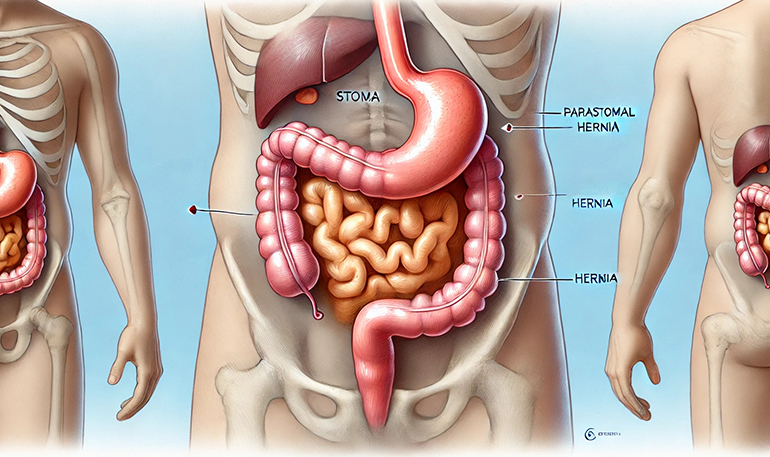
What Is a Parastomal Hernia? Can It Be Treated or Prevented?
A parastomal hernia is an incisional hernia associated with a stoma – the surgical opening where the bowel is brought out through the front of the abdominal wall. Its overall frequency is not known exactly, but it is estimated to exceed 40% within the first year after a stoma is created, and the rate rises to around 50% the longer a patient lives with a stoma. Most patients have no symptoms other than a bulge around the stoma. However, about one in five of these patients needs surgery – either for stoma-related reasons (difficulty managing the stoma bag, pain, skin problems, bleeding, etc.) or for hernia-related reasons (bowel obstruction, bowel becoming trapped in the hernia or losing its blood supply, or the hernia growing large enough to affect quality of life).
Main Risk Factors for Parastomal Hernia
Age, obesity, diabetes, smoking, physically demanding work, systemic or local infection, a weak abdominal wall, COPD or chronic cough, steroid use, certain immune and connective tissue disorders, and cancer.
The frequency also varies with the type of stoma created.
Preventing a hernia requires marking the stoma site in advance and using meticulous surgical technique. In some cases, a prophylactic mesh is placed to prevent a hernia from developing.
Not every patient with a parastomal hernia needs surgery. Some can be managed without an operation using other measures. When treatment is required, open or minimally invasive (closed) surgery is possible, taking into account many factors such as whether the stoma can be closed, the anatomy of the abdominal wall, previous operations and the course of the disease.
Ask the Doctor
+90 312 468 94 76